Step 1: Consider the location of your concrete base
Carefully choosing the location for your concrete base is important. You should consider various factors to ensure that the foundation is strong and properly positioned.
Avoid standing water
To prevent water from seeping under the panels, we recommend elevating the base. This will help avoid standing water and improve the durability.
Ensure proper drainage
If the ground around the base slopes down, dig a trench and fill it with gravel to create a barrier. This will also create a soakaway to ensure proper drainage. If your driveway slopes towards the garage, adding a gulley will redirect water away from the base, keeping it strong.
Check the surroundings for trees, foliage, and nearby buildings
If you are considering an up and over door, check for any trees or buildings that may overhang and be in the way. Trees and buildings can also create disruption during the garage build, so ensure that there is enough room for equipment, workers, and the structure itself.
Step 2: Prepare the ground
Levelling the ground before setting up the shuttering will simplify the process, ensuring a consistent thickness of the concrete.
Assess the Ground Conditions
Assess the ground before building your concrete base to ensure a strong foundation. This will prevent future structural problems.
If your ground is soft, you can strengthen the concrete by adding steel mesh. Alternatively, ask your concrete supplier about ‘fibre-crete,’ a special type of concrete that uses fibrous materials to enhance its performance. Don’t pour concrete directly over turf as it will decay and make the foundation unstable.
Always Use Hardcore
You should use hardcore before laying a concrete base, regardless of the ground conditions. Hardcore is important for stability, drainage, and preventing subsidence, creating a strong foundation for buildings.
Implement Damp Proofing
If your site is prone to dampness, use a thick plastic sheeting called a damp-proof membrane. Make sure the membrane covers the entire base to prevent uneven drying rates that may result in cracks.
When pouring concrete against a wall, use damp-proof sheeting between the concrete and the wall to prevent dampness from transferring to the wall.
Step 3: Set up the Shuttering
To make sure the site is ready, set up the shuttering at least one or two days before pouring the concrete. It should be stable enough for you to walk on without any movement. Since concrete is heavy, it can displace the shuttering if it is not firmly secured with timber stakes and nails, or screws.
Use a suitable weight of shuttering material, ensuring that it is completely flat, level, square and slightly larger than the planned garage size. You should avoid creating a ‘slope’ in the base of the concrete garage, as this will cause the entire structure to lean.
Check for squareness by measuring diagonally, and make the internal dimensions 150mm longer and wider to accommodate brackets. Create an opening in the shuttering for easy wheelbarrow access during concrete pouring. This simple setup guarantees accurate placement of the concrete where needed.
Step 4: Select your Concrete Supplier
Once your site is fully prepared, it’s time to select your preferred concrete supplier. We suggest that you do not try to mix the concrete yourself on anything above 1 cubic metre and opt for using a ‘barrow-mix’ company instead. They will provide the exact amount of concrete required, preventing any under or over ordering.
To make finishing concrete easier in hot weather, ask the concrete company for a wet mix. Furthermore, request that the concrete be poured directly onto the base area. When there are only a few wheelbarrows left, move the shutter ‘door’ and pour the last bit of concrete onto it.
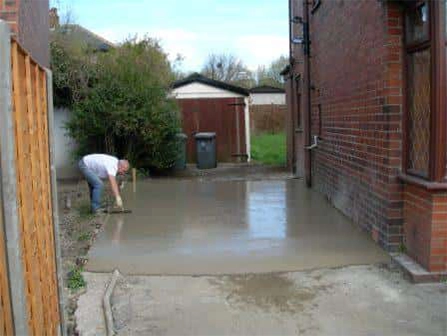
Step 5: Lay the Concrete
During the pouring of the concrete there may be spillages between the concrete truck and your base. Clean up any spillages using a hose pipe, but before the concrete dries.
While pouring the concrete, use a rake to make it as level as possible with the top of the shuttering. Raking concrete is easier than shovelling it.
Use a straight-edged tamp that is slightly wider than the base to remove extra concrete and smooth the levelled surface. You can do this by dragging the tamp across the top of the shuttering. If you are working with somebody then work from each side. If you are working alone, stand in the unlevelled part of the concrete and work from within the base.
For a professional look, use a ‘float’ to even out the outer edge of the concrete foundation. If you require a fully floated base, it is advisable to utilise a wide concrete float on a pole, which can be rented from various hire shops.
If you need a ramp at the front of the base, you have a few options. You can:
- Concrete it with the shutter in place and leave it.
- Remove it after the concrete sets (if possible).
- Once the base has set and the shutters have been removed, concrete the ramp separately on a different day.
To achieve the best outcome, keep the shuttering in place for a few days and let the concrete set. Wait for at least 7 days before installing your building.
Extra Tips and Tricks
- Avoid rinsing off spilled concrete into your drains as it can harden and block your drain over time.
- Pouring concrete with someone else is always preferable, instead of attempting to do it on your own.
- Rain won’t stop concrete from hardening, but you may have to use a PVA seal later to prevent a dusty surface.
- Shield the completed base with a plastic cover if the rainfall gets intense.
- If in doubt, call in Dencroft, the concrete garage experts.
Prefab concrete garage installation experts
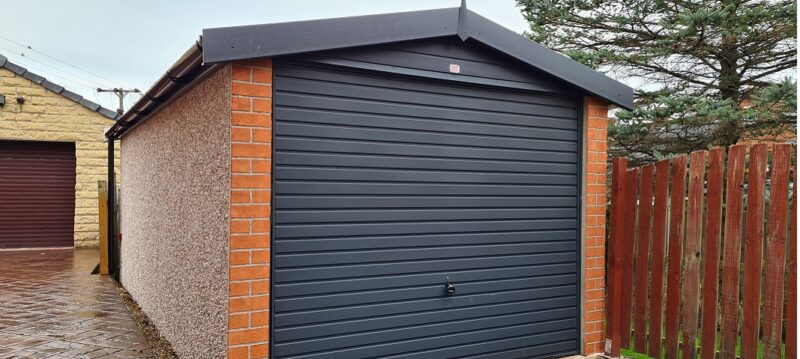
Contact Dencroft, the prefab concrete garage experts, for a durable and reliable start to your construction project. Our team of engineers have expertise in the end-to-end process of building prefab concrete garages. Please get in touch with us today for a no obligation quote.