
Author: Dencroft Garage Experts | Last Updated: April 2023
Undoubtedly, the ‘garage’ has evolved. With house prices on the increase, many homeowners are looking at the space they have and how best to utilise it.
The garage is usually the last place people think of, generally looking upwards (loft/attic) for expansion or opting for space saving walls internally. However, garages are ideal areas to really bring in that space your family craves but, like many other homeowners, your garage may be lacking warmth.
If you feel your garage has the potential to add space but feels cold and uninviting then now may be the perfect time to consider insulation.
We’ve compiled a list of the most commonly asked questions we hear from our customers with the aim of addressing how and why you should consider insulating your garage:
[lwptoc]
Should I insulate my garage?
You’ve come to the realisation that your garage can do more for you and now you need to determine if it is worth insulating your garage. The short answer is yes!
If you plan to use your garage space for a home office, playroom, gym etc then insulating your garage will provide you with warmth and a reduced energy bill!
Insulated garages are also great for protecting upholstered items as well as ensuring those pesky pests stay away!
The most obvious benefit of insulating your concrete garage is that it will be a nice temperature no matter what the weather outside is doing. There’s no point investing in a garage space if you’re only going to be able to use it in the warmer months of the year.
Insulation means your garage will be accessible and have a toasty temperature all year round. This is particularly useful if you use your garage as an office or DIY workspace as freezing conditions will make it unusable.
How do I insulate my concrete garage?
Insulating your concrete garage falls under 3 core categories: roof, walls and floor.
Depending on what you intend to use your garage for, we would always recommend starting with your walls.
With a variation of insulation solutions available, our first question will always be if it is a detached garage or adjoined to your home. This determines the complexity of the job and the type of insulation you’ll need. Detached garages may benefit from a stud wall that is then filled with insulation materials.
Roof insulations vary based on the type of roof you have i.e. flat or pitched. Dependent on the roof type, you can either opt for a cold roof installation or a warm roof garage installation.
Finally, a floor installation will add the extra warmth your garage needs. You’ll need to check the ground to ensure it is flat and free of any moisture. Once this has been determined, you’ll then need to decide between a rigid foam installation or a wooden foam installation, commonly referred to as wood sleepers.
How much does garage insulation cost?
There is no fixed price.
Garage insulation costs vary dependent on the requirements and the garage itself. Your garage may benefit from a single insulation type or it may need a combination of roof and walls.
Can you insulate a brick garage?
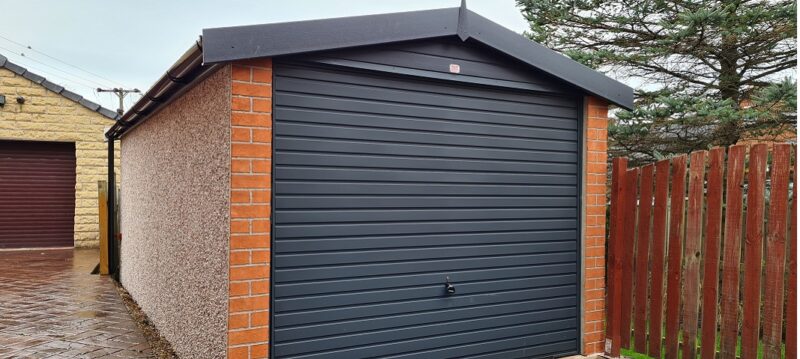
We have been designing and building brick garages since 1947 so we speak from experience, yes – you can 100% insulate a brick garage!
Our brick garages come in 2 distinct styles: Denstone and Denbrick, both of which are installed with a 10-year guarantee.
So when it comes to added installation, these garages are easy enough to insulate. Generally, when insulating a brick garage you can either insulate the external walls (most suitable for detached garages) or the internal walls.
In the UK, internal wall insulation for brick garages is the most popular. This entails creating a stud wall or plasterboard which is normally filled with insulation materials.
How do you insulate a garage roof?
Garage roofs can either be flat, pitched or come with a room above. Based on this, the ideal insulation for your garage roof varies.
At Dencroft, our standard garage roof is created using corrugated cement fibre roof sheets. However, because we understand that needs vary, you can use alternative materials for your garage roof.
Insulating your garage roof is one of the most popular and cost-effective solutions available on the market.
Currently, there are 3 types of insulation solutions available for garage roofs: spray foam, fibreglass and rigid boards.
All three have varying benefits and recommended solution is very much dependent on the type of garage you have plus its usage.
Insulation As a Sound Barrier
Insulating your concrete garage provides a sound barrier, stopping sound from coming in and out of your home. If your garage is used as a workshop, it stops your neighbours from getting annoyed at the constant noise of power drills. Or if your not-so-musically-talented kids use it as a room for drums or violin practice – an insulated garage means you won’t need those earplugs anymore.
Garage Insulation for Security
Thieves look for the easiest point of entry into homes and typically try garages as their first port of call. This is why safety and security are paramount, and insulating your garage simply adds another layer – making it even more difficult for burglars to get into your property. If you have a good quality garage door to boot, the chances are intruders will soon give up and walk away. Be sure to keep your garage secure and locked when not in use.
Summary
To conclude – insulating your garage will help retain heat, protect items as well add warmth to your new room. In some cases, using the right insulation for your garage can even add value to your home.
[wpforms id=”13814″]